TH'E SUSSEX JAZZ SUITE
After writing the Brighton Jazz Suite I dithered a lot about what to write next. What I've finally come up with is a suite about East Sussex - a county in the South of England which has a lot of interesting material to offer. It also means that I can add to the suite afterwards to keep it evolving and to focus on certain places or things, depending upon where the band can get a gig.
Here is a map of the county of East Sussex. Brighton and Hove is included within the county on a cermonial basis only and is a self-governing entity.
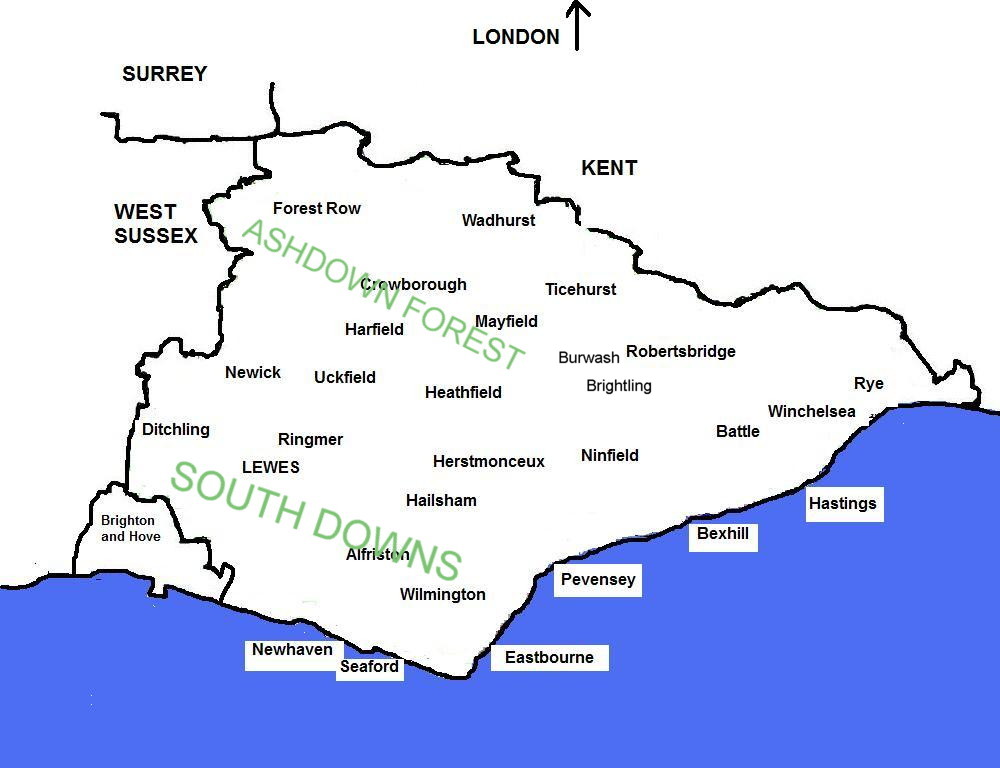
Some background information
The South Downs is a range of chalk hills which stretches from near Chichester in West Sussex to just outside Eastbourne. The word Downs comes from the Saxon word dun which means hill. Along the coast to the east of Eastbourne the land is flatter. Beyond the Downs to the north, is a (mainly clay) plain known as the Low Weald which gives way to the High Weald consisting of sandstone, the highest point being at Crowborough. Ashdown Forest - an ancient deer-hunting forest - covers a lot of the High Weald, although it has shrunk to half of its original size. It is a predominantly heathland area. In fact the word forest originally meant a wilderness which lay beyond cultivated and settled land, rather than being anything to do with woodland per se. The word Weald is a corruption of wald meaning woodland.
No-one can accuse the Saxons of not having a sense of humour in calling hills Downs. So what did they call valleys? The answer is combe or coomb while dean/dene means a little valley. Sometimes you will see the word bottom as in Breaky Bottom, but that's a later Middle English word. (Incidentally, hurst means wood, mere means pond and leigh/ley/ly means a wood or a clearing in a wood. You come across these words in many place-names in Sussex.)
For hundreds of thousands of years, early humans have come to England. In the early days this was made easier by the fact that until 350,000 years ago, Britain was not an island but joined to the continent in the East Anglia region by what is known as Doggerland. It is thought that the practice of dogging originated here. With sea levels much lower during the ice ages as so much water was tied up in the ice-caps and glaciers, Britain was accessible to hunters from Europe. In the milder spells hill-forts on the South Downs were built, as at Coomb Hill at Jevington near Eastbourne and Mount Caburn just outside of Lewes. But in the colder periods the dense forests of the Weald were more hospitable places.
It is assumed that the earliest settlers could not stand the intense cold of the heights of the ice ages and perished or went on extended holidays to warmer countries for several thousand years.
East Sussex was once part of the larger county of Sussex - the kingdom of the South Saxons, formed in 477AD when Aelle arrived by sea at a place called Cymenshore, the whereabouts of which scholars are still unsure about.
In the 12th century, the religious administrative area known as the See of Chichester was split into two archdeaconries, based in Chichester and Lewes. In 1974, the two distinct areas became respectively the counties of West Sussex and East Sussex. No-one can accuse the people here of being impulsive!
The music
Giving myself a large area to write some music about means I have a tremendous scope for continuously adding to this suite. Before going on holiday in 2011, I wrote the initial collection of tunes.
Before getting down to writing the arrangments, I played over the tunes whenever I had a spare moment and allocated who I would like to play solos on them. Certain types of pieces suit different players. I always try and ensure that everyone gets a good chance to be in the spotlight. A few of the soundbites were done on synthesizer, the rest were recorded at various rehearsals using a single microphone and without much of a chance to run-through the arrangements beforehand so the sound quality and precision of playing is not wonderful.
I am not writing the tunes in any order - just the ones which I fancy doing next, so the order on this page will change as I add new ones. I will add notes to each tune in italics. More photographs will be added over time. One thing I have to stress is that it is not enough to merely "paint a picture" of a place, which would result in nothing but long notes and no movement. This might be OK if I was writing for strings in an easy listening arrangement. But jazz requires some excitement - the peaks and troughs of climaxes. This is what makes jazz come alive. So I've had to look beyond the picture postcard scenery and delve into history and different times of the year to see a more varied picture. The Downs are beautiful, especially on a sunny day, but they also been forbidding places in the past, likewise, the coastal scenery is lovely on a calm day, but at the height of a storm they can be very dangerous places. The music therefore tries to reflect this.
If you don't want to know about the music, skip the paragraphs in italics.
To zoom in on a place or subject, click on the words below. To return here, click on the finger
Pevensey Castle
Battle of Hastings
Eastbourne
Banoffi Pie
Long Man of Wilmington
Lewes Priory
Lewes Bonfire
Gideon Mantell
The Battle of Lewes
Timothy the tortoise
Hindover
Herstmonceux
Winnie the Pooh
The leg-ends of St Dunstan
The coast
Smuggling
Shags
South Downs
The Weald
My Sussex Home
Dame Heffle's Cuckoos
Hastings Fisher Folk
Grey Owl
Mad Jack Fuller
Emma Lee French
Bat 'n' Ball
Black Death
Glyndebourne wind turbine
Cinq Ports
There is a saying which has become a motto amongst Sussex folk: We wun't be druv. This comes from a poem written in 1914 by a certain W. Victor Crook. Here are the first few lines:
Some folks as come to Sussex
They reckons as they know -
A durn sight better what to do
Than simple folks, like me and you.
Could possibly suppose
But them as comes to Sussex,
They mustn't push and shove,
For Sussex will be Sussex,
And Sussex won't be druv!
The phrase has much earlier origins and may have been first used in the Weald where the people were less under the control of a lord of the manor than in the more coastal areas.
The same sort of mentality can also be found in other rural places in England. When I was growing up in Cornwall in the 1950s and 60s Cornish people resented the way that some people from big cities who came to live in the county looked down on the locals, regarding them as country bumpkins.
The short piece of music I've written on this theme is quite straight-forward (just ensemble block chords) but stretching normal harmonic conventions by incorporating the third and fourth in many of the chords. The first chord is, from the top, Bb F, Eb D and the the rest of the tune is harmonised with the same voicing.
One of the most important places in East Sussex, arguably in the whole of Britain is Pevensey Castle, located a few miles east of Eastbourne.
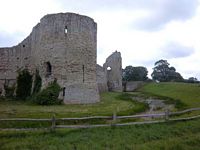
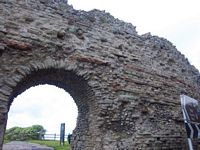
The castle was built, probably in 290AD by the Romans, and was called Anderitum or Anderida, meaning the Place at the River Mouth. It was built to guard against maurading Jutes and Saxons. At the time, the area was surrounded on 3 sides by the sea. Today it lies several miles inland. The first photo is a shot of the inner castle and the moat while the second photo shows the outer Roman walls.
In 491AD Aelle and his son Cissa led a Saxon invasion of the castle and slaughtered the (Celtic) defenders. In 1264 supporters of King Henry III took refuge in the castle after the king's defeat at the Battle of Lewes. You can learn more about it here.
Today, it is very unimposing. You can walk around the outer area, surrounded by the 12 foot thick, 28 foot high Roman walls (with or without a dog) free of charge, but for entry to the Norman Castle area there is a small fee. This is my tune called Anderida which you can hear for free!
This is an alto feature. It builds from just alto and rhythm section over several choruses to full band backing. The tune itself is rather angular and the chord sequence is quite difficult but a good alto player should be able to cope with this easily.

The Vikings had itchy feet and liked a good punch-up, just like the Celts and Saxons did. After their invasions and settlement of parts of Britain, the Saxon king of Wessex, Alfred the Great, made a treaty with the Danish warlord, Guthrum in 886 in which the area known as Danelaw came under Viking rule. The area encompassed much of Northern England and had its capital at York. The rest of the country was ruled by Saxons. I wonder if the North-South divide in Britain is a reflection of this.
In France, King Charles the Simple similarly made a treaty with the Viking warlord, Rollo in which the Vikings were given Normandy (a region for people from the North - Nord means north in French) to settle in, in return for loyalty to France and keeping other Vikings at bay.
In 1042, King Harold's army were encamped in Pevensey castle and only left in the summer of 1066 when they left to fight an invading army of Vikings under King Harald Hardrada at Stamford Bridge. It should be pointed out that King Harold himself was the son of Gytha Thorkellsdottir, who was the mother of Swejn 1 of Denmark. So King Harold beat King Harald in case you are confused by now. Harald claimed the throne of England, a claim going back to the dyslexic King Cnut the Great, otherwise known in England as King Canute.
On September 28th of that year (1066) William of Normandy, also known as William the Bastard for good reason, and his forces invaded England, landing at Pevensey before marching eastwards where he defeated King Harold at the Battle of Hastings on October 14th. He also had laid claim to the crown of England (King Edward the Confessor had promised it to him), but the Witan (a political advisory body to the king) gave the throne instead to Harold on the death of King Edward.
Let me put it this way. When the Vikings invaded an area that was made up of former Vikings (Danelaw), they were defeated by a king who was descended from the Vikings who was then beaten in battle by a man descended from the Vikings who was a Duke in France and became the first Norman English King.
The actual site of the Battle of Hastings took place on Senlac Hill, a few miles north of Hastings. Today the town of Battle marks the spot. The title of my piece commemorating the battle is therefore called Senlac. This word is a corruption of the English word Santlache meaning Sandy Stream. The Normans changed this to Sanguelac, meaning Blood Lake. The word was then abbreviated to Senlac. In 1070 (4 years after the battle) Pope Alexander II ordered the Norman conquerors to do penance for the deaths of so many people following the invasion. To comply with this, William the Conqueror built an abbey on the site of the battle with the altar of the church on the spot where King Harold was killed. The photo shows Battle Abbey as it now is.
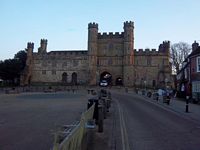
Much as I detest violence and warfare, battle scenes do give the opportunity for some exciting playing by the band. The format of the tune is A1 A2 A3 B A4. The arrangement starts off with the tune in F minor in unison and then there is a sudden modulation up a minor third and a counter-line is introduced. Another similar modulation occurs with both parts strengthening in texture. The bridge in another key follows and then we end up in a variation of the first part of the tune in E minor. Classical musicians are obsessed with key changes and there are a lot of rules about them in classical theory. Personally I don't give a toss - it's whatever sounds interesting to me. The second trumpet has a chorus to himself, then in the following chorus another trumpet player and a sax player start off, joined by a trombone in the next 8 and then an alto player in the last 8 before the bridge. By now you can probably guess - the brass represent the Normans and the saxes represent the Saxons. So we end up the chorus with the saxes and brass ad libbing alternatively and then everyone joins in. The drums take over with an open solo and the part of the tune is reiterated, played by the victors (the brass).
The Lady from Eastbourne. Many years ago I went to a concert by Sergio Mendes and Brazil 77 in Eastbourne. His opening remark I recall was that Eastbourne was rather like Rio. This caused a lot of laughter.
Bear in mind that the coastal area between Seaford and Bexhill is a big favourite amongst the retired, and the proportion of elderly people is very high here. So my title reflects this. This is how the lyrics of Girl from Ipanema might be written with this in mind;
Short and squat and drab and dumpy
The lady from Eastbourne goes out walkin'
And when she passes, each one she passes goes "Watch out!"
When she walks, she's like a barn dance
Arthritic hips in old ladies' pants,
And when she passes, each one she passes goes "Mind your step!"
O-ver the road I would help her
Past all the shops I would guide her
Up to the toilets I'd lead her
For each day when she walks near the sea
She needs to find somewhere to pee.
Grey and wrinkled with features drawn,
Hearing's bad and eyesight's poor, 'n'
When she passes, I smile,
But she doesn't see, not you or me,
She just cannot see..
This is not about anyone in particular. The point is that when she was young, she was probably just as beautiful and haughty as the girl from Ipanema. She might have lived a very interesting life, been all over the world, met a lot of famous people. She may have celebrated too in her time. But in Britain, people are judged by their looks and young people are idolised while the elderly are all too often despised or thought to be a nuisance. What a dreadful society we live in. This is the tune I wrote about her:
As you can tell, it's a jazz waltz, a bossa would be too obvious.
Here are some pictures of Eastbourne: the carpet gardens, the pier and the Grand Hotel. You may be interested to know that Debussy finished la Mer there in 1905 where he stayed with his mistress. He wrote to his publisher: The place is peaceful and charming. The sea rolls itself with a correctness truly Britannic... But what a great place to work. No noise, no pianos, except those delicious mechanical pianos. Little did he realise that just over a hundred years later the management would purchase 3 modern "mechanical" pianos (which can also be played normally) which have enabled them to cut down the number of days work for real live musicians, one of them being me. Personally, I blame Claude!
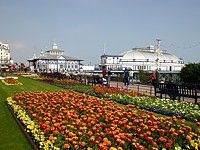
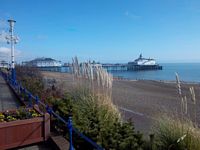
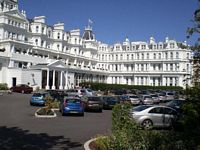
In the introduction, I've quoted a few notes from The Girl From Ipanema - this is so un-obvious that I've had to mention it beforehand. I want a soft mellow sound, so I've used flugels in unison with the altos to play the tune backed by trombones in bucket mutes. As the tune leaves no room for breathing, I've split the instruments in two parts so they can play alternate phrases but the overall sound will be the same. Then there is a tenor solo (homage to Stan Getz), with the trombones quoting the 2-note phrases from the tune as a backing. After bar 16, I've notched up the backing to include everyone playing in section work. This leads into a trombone solo, the first part is just with rhythm section, then the saxes are added on a soft unison line. After that comes 8 bars brass harmony with unison saxes/flute, followed by 8 bars solo trumpet. This pattern is repeated, but as the second part of the tune is only 12 bars long, I've added an extra 4 bars to give the solo trumpet a full 8 bars. This is no problem since there is no turn-around - the tune resolves on the first bar of the tune when it is repeated, so an extra few bars treading water will help to wind things down before the whole chorus of ensemble block chords which follow. As a contrast, this is followed by a chorus of bass solo. Then back to the tune. This time, I've divided up the 2 ingredients of the tune. The 2-note bit is played now by the trombones and tenors to start with, with the flugels, altos and flute playing the other notes. (Listen to the sound clip to distinguish the 2 parts.) The second part of the tune reverts to the original treatment and the piece ends with a short extension and a drum rit before the final chord.
If you go west along the coast from Eastbourne for a few miles you will come to Beachy Head. This is the highest point on the chalk cliffs - part of the South Downs - rising up to 162 metres (530 feet) above sea level. Although it is a beauty spot, it is also a place where people have come to commit suicide with 61 percent coming from outside East Sussex. For people tempted to do so, please think first. Think of the people who have to face danger themselves in retrieving your battered body. Think of relatives who may have to identify you. In other words, think of the grief it will cause other people. Look at these photographs and think again. The inscription in front of the cross reads: " - I love you, son".
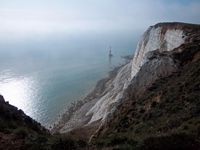
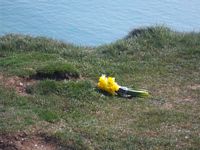
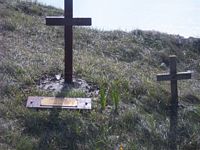
Beachy Head was also the sight of a sea battles - the battle of Portland in 1653 and the battle of Beachy Head in 1690. The name Beachy Head is a corruption of the Old French Beauchef, meaning beautiful headland.
I wanted to convey in the music the feeling of vertigo you can get by looking down from a great height on to the waves crashing on to the rocks below. I do this by use of dynamics - a series of short crescendo-decrescendos. This occurs every 2 bars for the first 24 bars (2 times 12 bars) and in the final 8 bars of the tune. Dynamics are also an important ingredient of the whole arrangement, almost as important as the notes themselves. After a long piano solo Ithis is the sort of sequence that I relish), there is a long tenor solo. There is then a long block ensemble shout chorus before a repetition of the first phrase of the tune harmonised in different ways. Here is a part of the piece at its first rehearsal:
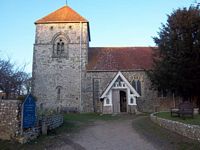
Just a few miles inland from Eastbourne lies the small village of Jevington. Originally called Geofa-ing-tun (the settlement of Geofa) and dating back to Saxon times, it was heavily involved in smuggling in the 18th century with contraband stored in the rectory and in the pub. The kingpin was a certain Jevington Jigg, the landlord of the Eight Bells pub. He was playing cards when the authorities came to arrest him and quickly donned a petticoat, bonnet and cloak and escaped.
I love the story about the vicar of the church who found himself presented with a mechanical organ. As the organ could only play one tune, all of the psalms had to be sung to this, until one day after finishing playing the usual tune it burst into a very jolly tune called Little Drops of Brandy. No-one was able to stop it and in exasperation, the vicar picked up the organ and ran down the lane with it still playing and threw it down the village well.
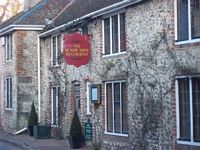
There is a restaurant in Jevington called The Hungry Monk (jazz players take note!) which is famous for another reason: Banoffi Pie. It was dreamed up by the chefs, Ian Dowding and Nigel Mackenzie in 1972.
I have written a tune called Banoffi Pie (This is how he spells it and I'm sticking to that). It suggests a rather laid-back tune to me - something to be indulged in and savoured. Here is the tune:
Food in jazz is often associated with bluesy pieces. So this follows suit, although it is certainly not a 12-bar. It should be in 12/8 but I have written it in 3/4 to make it easier to read. The tune starts with trombones in 6ths, doubled up on each part playing in plungers to get a dirty bluesy sound. In the next section, the tenors and baritone are added leaving 2 of the trombones free to play some low pedal notes. In the middle section the saxes take over in unison with sustained and shock chords from the brass. And in the final section the trumpets play the tune, with trombones on the lower harmony note to begin with before playing some low chords. The second chorus is an alto sax solo. This builds from just rhythm section backing in the first part, then adding some legato backing and then eventually more powerful chords from the horns. After a tag, the alto has 4 bars to wind down, like taking a cold shower after a good something-or-other. The bass(-guitar) then has a solo with just drums for the first section, adding organ for the next section and then high unison saxes and brass chords for the middle. No problems of drowning out a bass guitar, so it can become quite loud. After this, I let him off his lead and he can wander about freely by himself until he brings in a short vamp into the final part of the tune as in the first chorus. A repeated phrase (to which you could sing the words "Banoffi Pie") finishes off the piece with a muted trumpet playing some fills, like a person licking his lips after a good meal.
Between Eastbourne and Alfriston as the crow flies there is the small village of Wilmington. This is an ancient settlement going back to pre-Saxon times as burial mounds have been found nearby. Here, cut into the Downs, is the white figure called The Long Man of Wilmington. The figure, built on a chalk curved hillside is 226 foot high and the perspective is perfect when viewed from afar. How this was achieved is a mystery, as is the date that it originates from. Some people suggest the 4th century AD, while others think it may have been constucted by monks from the nearby Priory between the 11th and 15th centuries. It has been suggested that it might even date back to 3480 BC to mark the constellation Orion's movement across the top of the Downs.
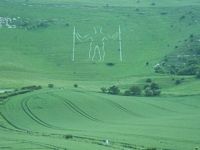
I do pity him. Out there in all weathers, stared at by strangers and occasionally molested (at times in the past a phallus has been added to him, giving a new meaning to the name, Long Man). The only company he has are the birds. For the sake of the music, I have imagined him having a bit of a love affair with a small bird. The bird says to him "Come fly with me" (obviously a fan of Frank Sinatra) but the long man cannot - he is well and truly grounded. Here is the music I wrote for him:
I have tried to conjure up something misterious - the chord lacks a third and has a rather lonely and desolate sound. The notes are, from bottom to top, F C G D. The first part of the tune (20 bars) is harmonised with the same voicing. From the bottom, the notes are played by bass trombone, 3rd trombone with arco string bass playing both in 5ths, then 2nd trombone unis with 2nd tenor and 1st trombone. The trombones are all in bucket mutes and the saxes play subtone. In the second part of the tune, the harmony slightly changes and 4 flugels are added, doubled by alto, 2 clarinets and flute. My reservation before hearing the results are that the clarinet/flugel might sound too military, in which case I will change the instruments around. The first solo is by the bass trombone, as befitting a manly figure. It is followed by a flute solo (a bird). They then swap phrases and solo together before the tune is repeated again but with some solo fills by some of the other horns (sightseers, maybe, or sheep). Rather an operatic piece you might think. Maybe we should perform it at the opera house, Glyndebourne.
The county town of East Sussex is Lewes, a historic town in which there are some wonderful old houses and a Norman castle. The word Lewes, pronouned like the American name Louis (but not like the French Louis) is derived from the Saxon word Hlaew meaning hill, as the town is indeed built on the side of a hill beside the river Ouse which flows in a gap in the South Downs.
There is a Neolithic hill camp on Mount Caburn which overlooks Lewes on the eastern side. The town and the local area was also important to the Romans. The Saxons developed the town and gave it its name, and recognising its stragetic defensive position, they built a castle here. When the Normans arrived, the rape of Lewes (a large administrative area centered on the town and stretching from the Surrey border to the sea) was given by William the Conqueror to William de Warenne who built a castle on the site of the Saxon castle. He also built the Priory of St Pancras on flatter land a short distance away on the site of a former Saxon church. William de Warenne and his wife Gundreda had visited Cluny in Burgundy, France in 1077 on their summer holidays, and after a few glasses of the local wine he decided to build a replica of the Cluniac Priory in Lewes.
The great church (a part of the priory) was begun sometime after 1140AD. When it was finished, it was larger than the cathedral in Chichester. Other buildings included an infirmary, a bakery, fish ponds, a hospitium (where guests were accomodated), a frater (a refactory or eating-place), a dorter (a dormitory), a rere dorter (a communal toilet), a chapter house and a dove house - in fact, it was an enormous complex of buildings which would make the Priory self-sufficient. By the middle of the 13th century, 100 monks lived there, but this number declined as a result of the Black Death in 1348 and the mismanagement of properties elsewhere belonging to the Priory. The Priory became very important and influential to the country as a whole and owned 20,000 acres in Sussex and lands elsewhere as well as seven daughter priories. This is how it might have looked at the time. Following the dissolution of the monasteries by Henry VIII (see Wikipedia to find out about that), the priory was destroyed in 1538 and many of the stones were used in other buildings in Lewes, for example, Southover Grange, built in 1572, where the diarist, John Evelyn lived. Recycling is not a new thing! For those of you who don't know what a diarist is it's someone who suffers from diarrhea. In spite of the destruction of the Priory, there are still some ruins which visitors to the town are not always aware of - you can find them just beyond the former football ground. Who knows, the monks might have also played football in this area. Here are some photos of the Priory ruins and the grange.
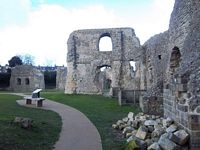
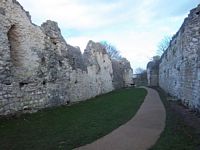
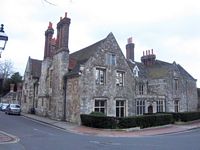
I wrote a piece about it some years ago and have now turned it into a big band number. The tune is called Friars Walk...and sometimes skip - I'd better explain that. There is a street in Lewes called Friars Walk which leads from Station Street (the Victorian station was built near the ruins of the priory) to the Cliffe area of town where there is a brewery. I had in mind that the Friars would sedately walk into town along the road, have a few bevvies and then skip back home. OK, I know the brewery was built many centuries later, but it's an interesting idea. Here's the tune:
It is the fate of the trombone section to represent the monks. The first chorus is in unison without a bass line or harmony to make it sound like plainsong. In the second chorus the flugels play the tune while the trombones play simple 4-part harmony and the saxes play an interweaving unison line which enables the brass to breath at the end of phrases. Each of the trombones then solos. There is then an ensemble part. I had intended to use just quotes from Thelonious Monk's tunes but it proved too bitty. At the end of the arrangement the trombones again play the tune in unison - now the monks are back in the Priory after a good night out.
One thing that Lewes is famous for is the celebration of November 5th (Guy Fawkes night) when people dress up in period costumes, parade down the main street and then gather around various bonfires to set off fireworks. In Lewes, this not only celebrates the foiled plot to blow up parliament in 1605, but also marks the burning at the stake of 17 Protestant martyrs in 1556 who were killed for practising their faith. A plaque commemorating this (far right) can be seen on Lewes Town Hall (middle picture). The Town Hall can just be seen in the first photograph at the top of the road. Thank goodness people are now tolerant of other denominations and religions!!!
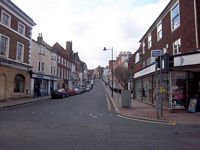
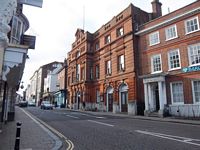
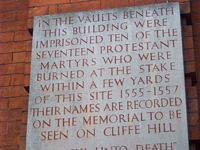
Here is a tune to commemorate the Lewes Bonfires, aptly called Bonfire.
Listen to the whole piece played at the Watermill Jazz Club here
The tune is voiced for saxes in just 2 parts (mainly thirds), but to give a bit of variety to this I have divided the trumpets and trombones into 2 of each, one with cup mutes and the other with plungers which play alternative phrases. After the tune, the key changes for a trumpet solo (an instance where one key is better suited for the tune than for the solos.) I let him run amok for the first chorus before unleashing some musical fireworks on the next chorus - he quite likes a good bang. A tenor solo follows this and to mark the transition to a new key and new soloist I also change from Latin to swing. No-one gets a chance to sleep in my band. A bit of tension is built up by the other sections and then in the second chorus I gradually add the other tenor and the altos for a communal "singsong" - a nice bit of organised chaos to reflect bonfire night. In contrast, this leads to a quiet ensemble passage voiced in thirds, then as second inversions of triads and then adding the major sevenths to these chords as volume and intensity increase. To finish off the firework display I unleash a big rocket before returning to the theme, this time with open brass with muted trumpet fills.
A celebrated former resident of Lewes was Gideon Mantell: a man of many talents. Born on the 3rd February 1790, he started work as a pharmacist and dentist before studying medecine in London and becoming a Member of the Royal College of Surgeons and a Midwife, delivering 200-300 babies a year at one time, which somehow still left him time to indulge in his passion for geology and the categorisation of fossils he found locally.
His most important find (some say it was his wife who found them) were some teeth, which (to a lot of derision at the time) he claimed belonged to a dinosaur he called Iguanodon. He is credited with discovering 4-5 genera of dinosaurs. He died in 1852.
He was also a very humane brave man who once took a woman from the gallows because he stated that she was not guilty of a crime. He also disproved of the treatment of patients at the Royal Artillery Hospital in Ringmer where he worked for a while.
It was discovered in a postmortem examination of Mantell that he suffered from scoliosis in which the spine is curved from side to side. A portion of his spine was removed and pickled and stored in the Royal College of Surgeons in London. How ironic that one of Britain's greatest palaeontologists should have one of his own bones on display for others to discover! The person whose decision it was to put Mantell's spine on display was Richard Owen, a fierce rival of Mantell who opposed his theories, prevented publication of one of his works after his death and wrote a damning obituary about him. It is also ironic that Mantell's surgery in Clapham Common where he lived for the latter part of his life is now a dental surgery, seeing that he is famous above all for discovering the tooth of Iguanadon.
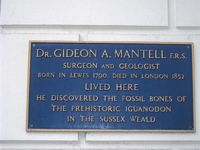
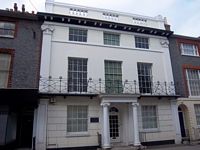
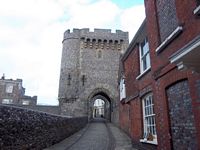
This plaque to Mantell can been seen next to the door on the left hand side of the house. The architect of the house, incidentally, was Amon Wilde - see Brighton Jazz Suite. The Barbican, part of Lewes 11th century castle, is just beyond the house on the right hand side.
To my mind, Gideon Mantell was a wonderful man and so I have written this tune in his honour. The soprano solo here is by Simon D'Souza.
I call it Mantell Piece.
The tune is 24 bars (8+8+8) and ends up in various unexpected keys. It is first played by clarinet and single-note piano against trombones with cup mutes. Then the flute is added to the clarinet/piano tune and the other saxes double the harmony parts. In the last part of the tune, all of the saxes play the melody and trumpets in harmon mutes emphasise the harmony an octave up from the trombones. There is then a soprano solo followed by a brass soli and then sax soli section. Then each of the trumpets gets to play a short solo in rapid succession, ending with all of them at once, but for only a few bars before the third trumpet is left by himself, with not even the rhythm section to keep him company. When he is fed up with playing with himself, he plays the tune again, the trumpets join in for the second eight and the saxes again finish things off.
I should not omit a very important event that took place in East Sussex - The Battle of Lewes, fought in 1264. King Henry III was annoying the barons because of his disregard for the Magna Carta, signed by his father King John in 1215 which limited the powers of the king. In 1258, the barons forced Henry to sign the Provisions of Oxford which specified that the king had to consult them in making decisions. But he also ignored this after a few years.
The barons got fed up with this and elicited the help of Simon de Montford, who was born in Montford-L'Amoury, Normandy but lived for most of his life in England and became the 6th Earl of Leicester. He also happened to be the brother-in-law of Henry 111, having married his sister, Eleanor of England. King Henry accused him of seducing his sister who was a widow and had sworn to living a life of chastity after her first husband, the Earl of Pembroke died...but sexy Simon made her forget all about that. Unfortunately, certain barons and the Archbishop of Canterbury did not approve of her marrying a foreigner and of not consulting them first. Simon fled the country and went on a crusade (as one does). It all gets a bit complicated next, but eventually the barons got over it and invited Simon back to England to lead their rebellion against the king. Family feuds have influenced a lot of history. Simon hated the idea of spending another Christmas with the bad-tempered Henry if he came back, so readily agreed to take up arms against his brother-in-law.
Both sides toured the country rallying support for their cause until they reached Lewes where the King camped at the Priory while Prince Edward positioned the cavalry at Lewes Castle. Simon de Montfort and his army meanwhile camped out at the village of Fletching, a few miles to the North. Simon tried to negotiate a settlement with Henry but he was rebuffed so they resorted to fighting it out.
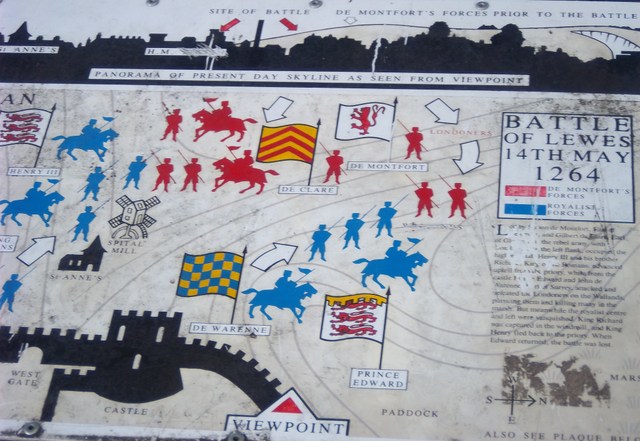
Unfortunately for Simon he had fallen off his horse and had to be taken around in a cart from which he directed his army. So it was that at the Battle of Lewes Simon de Montfort defeated the Royalist forces and captured King Henry and his son Prince Edward. (See photo below - put mouse over to enlarge.)
Prince Edward (Simon's godson) was given a lot of leeway in his captivity and one day while out hunting he simply didn't return as he should have done, which was not very sporting of him. The following year his army defeated Simon de Montford's forces at the Battle of Evesham. Up to this point since the Battle of Lewes, Simon de Montford had been the de facto ruler of the country.
Footnote: at the Battle of Evensham, Simon's body was mutilated, and his head, feet and testicles were cut off. Baron Morimer sent his head to Wigmore Castle as a gift to his wife, Maud (one way to get ahead). What happened to his testacles is not recorded.
He also set up a Parliament (literally a talking shop), enshrined in the Mise of Lewes, made up of representatives (ordinary citizens) of each borough in each county. This is the basis of present day democracy. Even today, anyone with the gift of the gab can be elected to parliament, and if they are chosen by the leader of the winning party they can be given the job of running various sectors of the economy for which they have no background, no training and no knowledge, guided only by the dogma of their own party. Some call it democracry; I call it lunacy!
A few miles north east of Lewes is the village of Ringmer, albeit a very large village. Ringmer has several claims to fame, apart from the fact that I live here! John Harvard, after whom Harvard University in the USA is named, married a woman from Ringmer - Ann Sadler. William Penn, who founded the State of Pennsylvania, also married a woman from Ringmer - Gulielma Springett.
Then there is Timothy. He (some say she) was born in the Province of Virgina in 1684 and was kidnapped by a sailor, or rather tortoise-napped as that is what he was. The sailor sold the tortoise when he got back to Chichester Harbour in West Sussex to a certain Henry Snooke who took it home with him to Ringmer. But it was not Henry but his wife, Rebecca, who looked after him for the next 40 years at Delves House in the centre of Ringmer.
Rebecca Snooke was the aunt of the Reverend Gilbert White, the author of The Natural History of Selbourne which has become a classic book about fauna and flora in England. When Rebecca died, Gilbert White took Timothy back to live with him in Selbourne. Being a meticulous natural historian he subjected Timothy to various tests: weighing him every six months and observing his every movement. He was shouted at with a megaphone to see his reactions, had his pulse taken and was dropped into a tub of water to see if he could swim - he couldn't. No wonder he escaped from his new home in Selbourne once, but didn't get far and was found after a week.
A year after Gilbert White died in 1793, Timothy also died. The shell (carapace) is exhibited in the British Museum of Natural History.
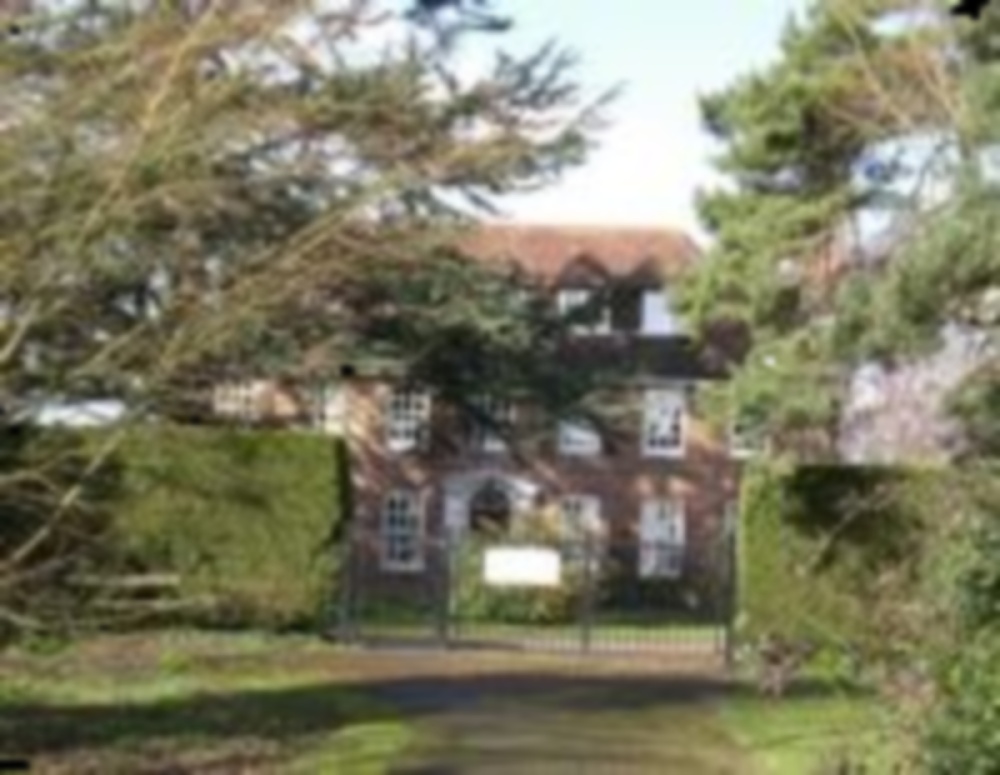
Delves House, shown above, has served as a vicarage, a private dwelling, the home of Sir Thomas Beecham (the conductor), the baracks for Canadian forces during World War 2, and an "old folks home". It is now divided up into flats for elderly people. For a while, when it was an old folks home, I used to sell sweets there for a voluntary organisation. One day in the side-room where I kept the stock, I saw one of the residents in bed. "The usual", I said to her, picking up her favourite chocolate bar. There was no reply - quite understandable really as she was dead. It nearly put me off chocolate for life.
The tune, however, is devoted to Timothy the tortoise and is called When Timothy met Gilbert. Here is the tune with the trombone played by Tim Wade.
The 2nd Trombonist plays the part of Timothy (with a plunger), so he has the tune to start with accompanied by just bass and drums. Why is is a blues? Well, it can be pretty depressing being a tortoise. The tune is repeated with the band playing the tune and the trombonist playing fills. There is then a chorus of piano fills answered by full band to give the trombone player a break and have more impetus for when he comes in in the next chorus with a solo. In the following solo chorus the saxes and flute have a little riff based on the tune. I put the baritone on flute and the lead alto on soprano to lighten the sax sound and keep the range up away from the trombone. In the next chorus, the brass play double tempo figures and the trombonist plays alternative bars. This is part of a ruse to contrast the rest of the band with the slow moving "tromtoise". The band gets rather carried away leaving the trombone with just drums for a stop-gap chorus next with band chordal interjections now and again - I wanted to keep the band from drowning out the trombone solo. After this the piece goes into double tempo with a trumpet player taking the part of Gilbert White. First chorus is with just rhythm, next with a trombone riff and in the third one the rest of the band play sustained chords. In the following chorus the trumpet plays 2 bars at the double tempo, answered by the trombonist playing 1 bar at the original tempo, and so on until the end of the 12 bars when he holds on to things, meanders about and then the tune is reinstated by the band. This time, the tortoibonist goes beserk in the fills - trying to keep up with the rest of the world. But the effort kills him off, as well as most of the audience I expect, just before the final band chord.
Between Alfriston and Seaford the road climbs over the Downs. At one point, there is a small car park leading to a wonderful vantage point over the river valley of the River Cuckmere leading into the sea a few miles away. This is one of my favourite beauty spots in the county and has been given the name Hindover which is an abbreviation of the full name - High and Over. There are so many beauty spots in East Sussex offering panoramic views. It always raises my spirits to come across them.
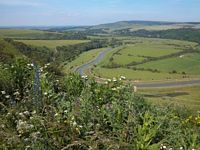
Hear the whole piece and see more pictures from Hindover on youtube here.
I think this is a very Englishy tune. I have given the melody to 2 soprano saxes in unison with the flute, while the chordal backing is provided by flugel horns and trombones in bucket mutes. Then the third trombone gets a solo, followed by the third trumpet and then they get 4 bar phrases each. It's only 16 bars long so I have modulated each chorus. After this, there is a sax soli for flute, soprano, soprano, alto and tenor - nothing too heavy. As the flute could get overpowered by the saxes I have put it in octaves above the lead soprano. I always assume the flute will be well-mic'ed up which tends to be the case. Then there is a passage for brass before going back to the original key and recapitulation of part of the tune. I'm not really sure about this arrangement - will have to find out when it is rehearsed.
The village of Herstmonceux, a few miles from Hailsham in the central area of the county, not only has a 15th century castle but also has, or rather had, an observatory.
Herstmonceux (pronounced hurst-mon-zoo - that must horrify a French-speaker!) is derived from either the Saxon word hyrst meaning wooded hill, or from the family name Herst plus Monceux. I would opt for the second explanation since Idonea de Herst, who came from an aristocratic family which owned the manor at Herst, married Ingolgram de Monceux, a French nobleman, in around 1200AD. The manor became known as Herst of the Monceux before being abbreviated to Hersmonceux. Just think, it could have been known as IdoneaIngolgam!
A descendant of the de Monceux family, Roger Fiennes, whose position was Treasurer of the Houshold of King Henry, built the castle - one of the first large brick buildings in the country - in 1441 on the site of the old manor house. The property changed hands several times and eventually ended up owned by the Admiralty in 1946. Unfortunately for them, it was a long way inland so they could not keep their warships there, so they did the next best thing. They used part of the land to build the Royal Greenwich Observatory there. The word Greenwich applies because it lies on the prime meridian which starts at Greenwich in London where the Observatory was originally sited.
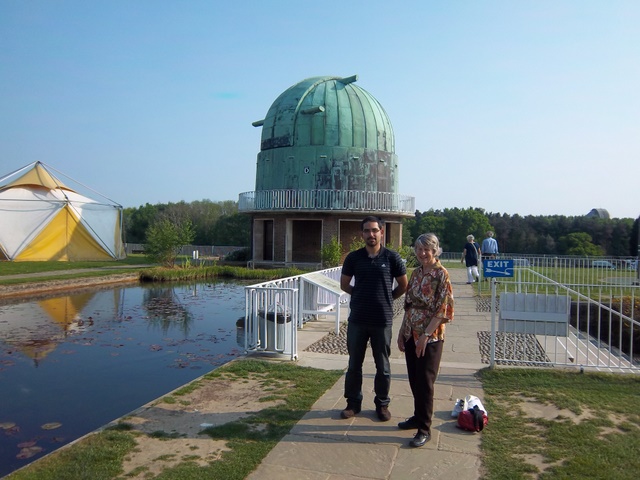
Within spitting distance of the castle, six large copper-plated domes were built housing telescopes, although one of them was never installed. Copper goes green when it is weathered and it was thought that this would blend in better with the fields around. Astronomers lived in the local village or in the castle itself and because no light was permitted, they had to find their way to the various domes by a network of paths using different paving and with different plants to guide them. In spite of this, several scientists fell into the ditches nearby or into the ornamental pond.
The Observatory stayed here until 1988 when it was relocated in Cambridge and one of the telescopes - the 100 inch (254 cm) aperture Isaac Newton telescope was taken to La Palma in the Canary Islands where light pollution is much less of an issue.
Today, the former observatory is part of a interactive science centre for children and there are guided tours of several of the domes which can be combined with a visit to the castle.
I wrote the piece Star Track about the Observatory.
To emphasise the twinkling of the stars and the broadness of the universe I used the technique of making each note of the tune remain sounding while the next notes are played - a bit like using the sustain pedal on the piano. This calls for extreme accuracy. I have learnt that it is most effective if some instruments actually play the whole tune, otherwise it can sound bitty. So I have got the flute and piano and lead trumpet and then the trombones playing the tune while the rest of the band play long notes on notes which form the tune. There is a tenor solo after that and then the band (high block chords) and soprano swap 2 bar phrases, leading into the middle section where the soprano takes a full solo. At the end of the middle bit, the soprano is left alone with the drums. After a while, the band plays long note phrases against it. Here I've used a variation on the way I treated the tune and when each new note is played the previous note which is played by others diminuendos in a rapid face. I think that there is a lot that can be done with dynamics to create special effects. Then it is back to the last part of the tune with a short coda. If it doesn't work at least I will have learned something. Here is the tune as played at the Watermill Jazz Club in Dorking. Be sure to read my comments below the video.
Many well-known authors have lived in East Sussex, including Virginia Woolf, who lived in Rottindean and Rodmell, Sir Arthur Connan Doyle, who wrote Sherlock Holmes stories, who lived in Crowborough, and EF Benson who lived in Rye.
The best known ones who are known throughout the world were Rudyard Kipling, who lived in Burwash and AA Milne, who lived in Hartfield. Both of them wrote wonderful children's books: Jungle Book by Kipling was made into a film, which I must have seen at least 10 times. He also wrote Puck of Pook's Hill. Then there are the ever-popular Winnie the Pooh stories, written by AA Milne.
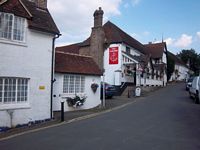
Both Burwash and Hartfield are very lovely unspoiled picture-book villages, quintissentially English. I had a hard job deciding which of these two outstanding authors to pay tribute to so I thought it would be nice to combine them. The short name of the tune I have written for them is
Oh Pooh! but there are also two longer titles - choose which one you like best: Pooh on Pook's Hill or Puke at Pooh Bridge. For once, my childish sense of humour is appropriate to the task in hand. Here is the tune:
The photo below shows the village of Hartfield while the photo on the video is of Pooh Bridge. Click here to see the video.
The tune is nothing like a jazz tune, more like a children's playground song. For the introduction, I intersperse each short phrase with solo drums copying the same rhythm. Then the tune is played in its entirety in a sort of unison but with the high notes played by trumpets and the low ones by trombones. The flute, soprano and two harmon-muted trumpets then have their say. This is repeated, but this time the bass notes are replaced by notes in a different key - a tritone away. There is then a repeated phrase leading to a repeat of the tune in 2-bar sections with the soprano filling between each section. This is followed by a trombone solo in half tempo. Backing is kept to a minimum as it's easy to drown out a trombone solo. Following this, the tenor and alto solo, swapping phrases at first and then playing together. After things have come to a bit of a climax, the rest of the band cuts out leaving both of them playing in different keys - yes, a tritone away. Finally they grind to a halt and the tune is reiterated, slowly at first and then accelerating away to reach the original tempo. The repeated phrase comes again and then a bar of silence, followed by a fragment of the tune to round things off.
Saint Dunstan who lived from 909 to 988 was once one of the most popular saints in England. He was born and grew up near Glastonbury in Somerset where he bacame a monk. He worked as a silversmith and metal-worker and is the patron saint of these occupations. He later became an abbot, a bishop, and then Archbishop of Canterbury.
Mayfield in East Sussex is situated in the Low Weald and for centuries this area was a centre for the iron industry, using charcoal produced in Ashdown Forest. Hence, St Dunstan was held in great esteem by the people of Mayfield who named the church after him. He is said to have founded the church.
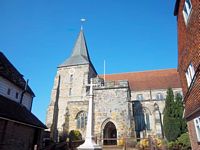
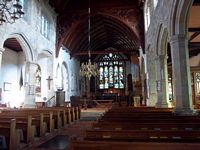
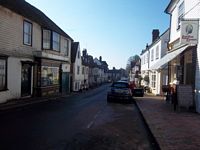
There are several legends about him, one of them that appeals to me is that when he was working at his forge, the Devil visited him disguised as a beautiful lady in order to tempt him. But he noticed the cloven hoofs below the dress and grabbed the Devil's nose with his red-hot pincers which made the Devil flee. The tune I have written about this incident is therefore called The leg-ends of St Dunstan Click on the title to hear the whole piece.
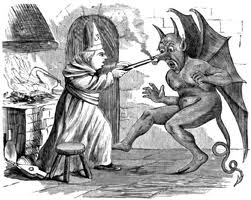
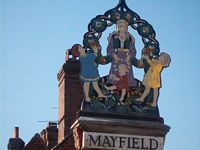
Nowadays there are probably fashionable women's boots shaped like cloven hoofs and St Dunstan would be arrested for sexual harassment, indecent assault and heaven knows what else. Incidentally, the word Mayfield is a corruption of the Saxon word Maghefeld, or Maid's field. If you visit you may not see many maids in the nearby fields, but you will see some lovely countryside and a very attractive village. Here are the two sides of the village sign
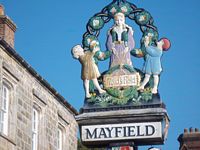
I've given the tune to the tenor sax to play as it fits the range of that instrument nicely. After the tune, various sections play a line in unison with the bass before it goes into harmony and then into more conventional brass versus sax writing. The tenor then has a solo, at first with just the rhythm section and then with trombones and then with all the horns. The solo section ends with a long vamp on F diminished (the last chord in the sequence. The tune is then played by saxes in unison with the last phrase played by unison trumpets. Nothing unorthodox about this arrangement.
The coast has a lot of importance for the county. For a long time, fishing was a major industry, but now it is only Hastings which has any semblance of a fishing fleet left. Invasions and the threat of invasions have been a constant concern. Several coastal towns have been burnt to the ground as a result of enemy action. During the second world war, many of the beaches were mined and pillboxes (low concrete buildings for gun emplacements) still exist in places, such as the Seven Sisters country park.
The exact position of the coast-line has varied over time. Some towns like Winchelsea and Pevensey which were once thriving ports have become stranded some distance from the sea due to silting. In other places, the coast has been eroded by the sea during stormy weather.
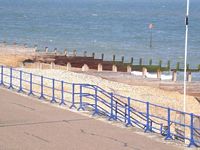
The photo shows a couple of the groynes on Eastbourne beach which keep the shingles from being totally swept away by the tide. In the winter, bulldozers smooth out the shingles. The situation is worse in Seaford because of longshore drift which moves the sand and shingle from west to east. In the 1980s the beach had all been swept away and more sand and shingle had to be redeposited there from elsewhere. Upkeep has to be done twice a year to keep it under control as can be seen here.
There is also the danger of the chalk cliffs being eroded away with disastrous results for any building built too near the cliff edge as can be seen in this photo taken of cottages at Berling Gap, between Seaford and Eastbourne.
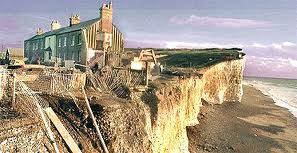
I remember taking some Hungarian visitors to Berling Gap to see the landscape once and came across 2 girls sunbathing topless. I suppose in hindsight I should have warned them about the dangers of erosion...but I didn't think of it at the time.
Near Beachy Head, the Belle Tout lighthouse was in danger of falling into the sea and the whole edifice was rescued by laying tracks along the ground and slowly moving the lighthouse further inland. Take a look at these pictures.
But let's not forget the more positive aspect of having a coast-line which is only just over an hour from London by train. Holiday makers and day-trippers flock to the coast to lie on the beach - oops, I mean shingles, which shows that British people are masochistic at heart. (I say this as someone who grew up in Cornwall where there are proper sandy beaches. I miss them.)
The sea and the shore have various moods. The piece of music I have written reflects this. I call it Shore Thing.
After a rippling free introduction, the first bit of the tune is played by trumpets with just 2-part harmony, provided by the trombones. Simple harmony can evoke scenes of nature and a sense of tranquility when played softly, but menace when played loudly. In the middle section, I briefly use open 4-part harmony before returning to the original plan. A trumpet solo comes next, with just rhythm section backing to create a calm atmosphere. Keeping it fairly gentle there is then some horn backing by the trombones in cup mutes and the saxes (2 sopranos and an alto). The voicing for both is a perfect fifth with another voice a tone below the lead. The two sections move mainly in contrary motion. The resulting chords are a mixture of concord and mild discord to stimulate the soloist. After the trumpet solo there is a block harmony passage for all the horns to create a stormier setting with much more disordant chords, at first all based on the F7sus scale and then "going outside". Then the two sopranos swap phrases before a modulation and the return of the tune.
Earlier on I mentioned smuggling. In one way or another a large percentage of the population of the county was involved in this activity, particularly since the sea lies to the south and London - a huge market for contraband goods lies to the north. Nowadays you can't go far, especially in the coastal region, without coming across pubs called such things as Ye Olde Smugglers Inne and such like. But for all the twee names, it is tempting to forget that smugglers were a pretty nasty bunch of ruthless men who would think nothing of murdering any customs officials who stood in their way.
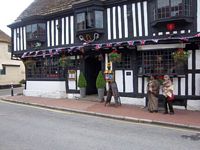
Photo of The Star in Alfriston, built in 1345 - one of the haunts of smugglers
There were several gangs of smugglers, the most notorious being the Hawkhurst gang just over the border in Kent, but their activities also took place in Sussex. At one time they threatened to sack the village of Goudhurst and murder all the inhabitants in revenge for the inhabitants of the village refusing to cowtow to them. But they met their match and were defeated by the villagers. There were also gangs of smugglers in Mayfield, Groombridge, Alfriston, Jevington, and Hooe. There is no better description of smugglers gangs than here.
Hooe, the last-named village mentioned above, is a tiny community (just over 400 in population) inland to the East of Eastbourne and not far from Herstmonceux. The row of lime trees which stand outside the Red Lion Inn signified that it was a safe house for smugglers. The landlord for a time was James Blackman, a member of the Groombridge and also associated with the Hawkhurst gang. The pub is also haunted - I was told this by someone in the bar there (we used to rehearse with a band in Hooe) who said that one night he was lying in bed when a cloaked figure appeared and vanished through the wall. Whether it was a smuggler or not, he didn't say. My tune about smuggling is called Hooe - What, when, where, why? Here is the tune:
and here is the ensemble passage
The piece starts out with a furtive solo bass trombone (not a smuggled one I'm informed). This is picked up by the bass and piano as a bass line to the tune played by unis saxes and flute with parts of the tune highlighted by harmon mutes. Harmony is also supplied by trombones in plungers. This is to create the atmosphere. One of the trombonists then gets to play some fills before getting full solo honours. A long ensemble passage follows this (block chords and then section work) before the bass trombone gets to open his bag of contrabanded licks. A shortened version of the tune then rounds off the arrangement. The tune is based on a string of diminished scales. This produces some interesting lines, but being an 8-note scale means constantly shifting between sharps and flats which might make it hard to read. We shall see.
Besides smuggling, another way of getting one's hands on a variety of merchandise was something which was done in Seaford. In medieval times, the town was an important thriving port, but the harbour silted up and the town was burnt down on several occasions in French raids. The population, or at least a section of it, therefore sought other ways to survive, namely by wrecking ships by putting false harbour lights on the cliffs and making off with the ships' cargos as they ran aground. This earned the people of Seaford the label cormorants or shags in the sixteenth century. A word of warning - if you visit Seaford, do not refer to people in this way. Shagging stopped here several cenuries ago - they are all completely shagged out now.
Of course there is more to Seaford than this. In Roman times, there was a settlement on the top of Seaford Head, with possibly a port in nearby Exceat, a few miles further east along the coast which in those days would have been an inlet of the sea. In the Saxon period, King Alfred the Great had a summer palace in West Dene, a short distance away, and it is thought that his main naval base against the Vikings was at Exceat. Since 1400, the village has no longer existed, thanks to the ravages of the Black Death and raids by the French. It is interesting to know that in the 1100s this area paid more in taxes than Lewes, mainly because of the lucrative wool trade.
Seaford was also an associate member of the Cinq Ports - see seperate section.
The town used to be at the mouth of the River Ouse which flows north through Lewes to Barcombe Mills and Lower Beeding, its source. In previous centuries (and still, on occasion) the river has caused severe flooding, particularly in the Lewes area, so in the mid-16th century it was channelised and its entry to the sea was diverted a few miles to the west to create a new port, Newhaven, from which cross-channel ferries now operate. This did not completely stop the river from flooding and over subsequent centuries various measures have had to be made to prevent this. Even the suicide of the author, Virginia Woolf in the Ouse in 1841 did not help!
In 1850, it was decided to try and halt the encroachment of the sea on the beach and town by blowing up part of the cliffs to act as a breakwater. Some 200,000 tons of chalk came down in the highly-publicised explosion, only for it all to be washed away by the sea.
Incidentally, in between Seaford and Newhaven is the hamlet of Bishopstone. It has a population of 200 with no shops or pub, but it does have a railway station (a long way off) and a church (St Andrews). The original part of the church dates back to 715 AD - possibly the oldest in the county. The bishops of Chichester used to come here for a retreat up until the 17th century. King Edward ll visited one of them here for a few days. The bishops built the first windmill in East Sussex in 1199. There was another mill nearby at Tidemills powered by the sea which was used to grind corn. Both mills are now well and truly gone. Not a bad set of achievements for such a tiny place.
Seaford is a good town to explore the surrounding area from. To the east there are the Seven Sisters chalk cliffs (see first photograph below), and to the north there are the South Downs and Oldy Worldy villages like Alriston, Alciston and Firle. The village of Litlington is not far away, where Mrs Maria Firzherbert lived. In 1786 she secretly married the Prince Regent, later to become King George IV in the local church, calling themselves Mr and Mrs Payne. It was a marriage - oh dear, I seem to have spilt the beans! Before they were married, he used to ride 18 miles from Brighton to see her. He obviously enjoyed a good ride.
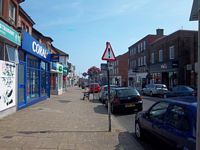
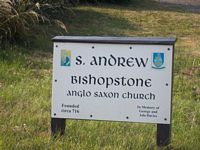
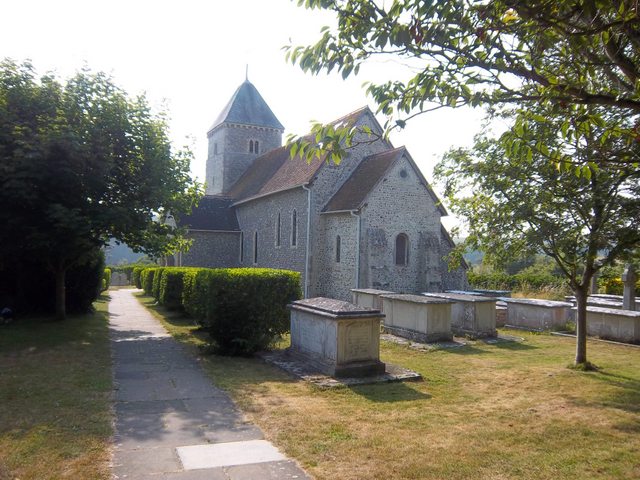
In Seaford itself (a shopping street shown above), there is a Grade 2-listed Martello Tower. These were built during the Napoleonic wars in the early 1900 century.. A total of 103 of them were built. The one in Seaford is the last in the chain, starting at Aldeburgh in Suffolk. It is now open as a museum.
I could not resist writing a piece about this topic. I was going to call the tune "Seaford shags", but in case the good people of Seaford might misinterpret this, I have shortened this to "Shags" to avoid any ambiguity. It is a very simple and basic piece with hardly any chord changes to negotiate for the soloists - trombone and tenor to give them a lot of freedom. Mark Bsssey will be guesting with us for its first perfomance on November 10th, 2013. I am very pleased to say that I have broken one of the rules of harmony in this and made a big thing of a major chord with an added fourth (or a suspended fourth with an added third, if you prefer) This gives a nice POW chord which works in this context...I hope. It is only fitting that breaking the law by shipwrecking is represented by breaking the rules of harmony. Here is part of the tune:
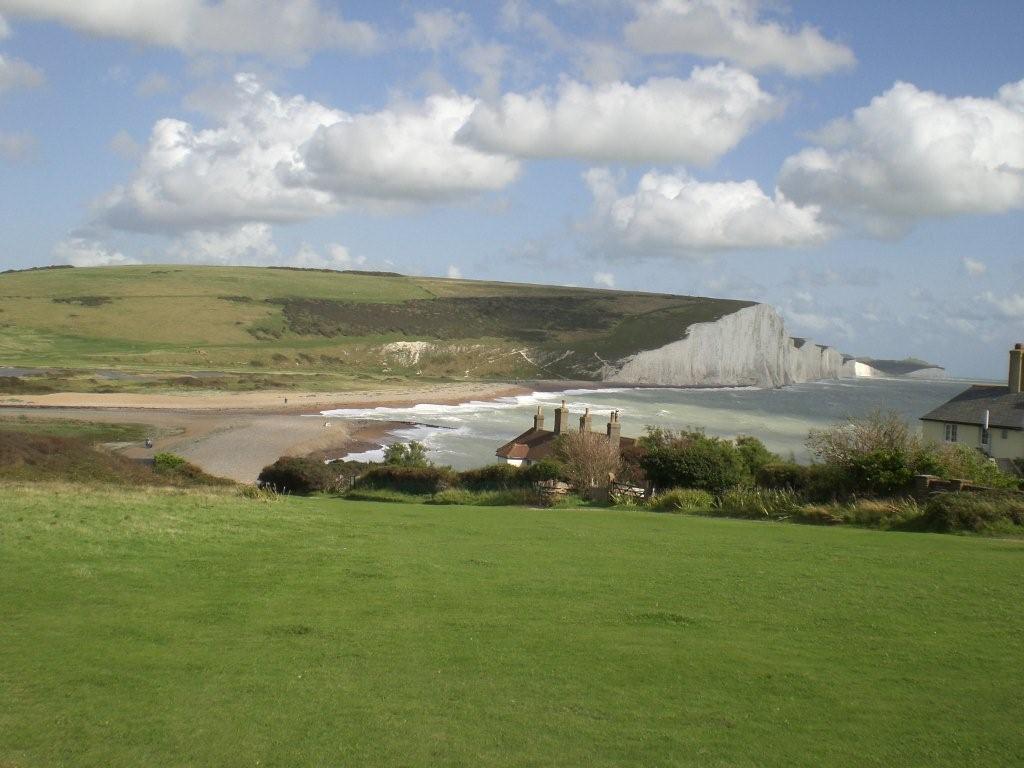
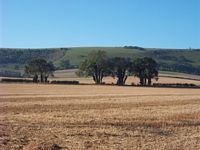
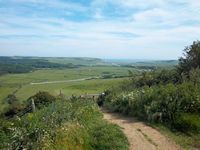
The South Downs plays such a prominent part in the geography and history of Sussex that I thought it deserved a tune for itself. The Downs from Winchester in the west to Eastbourne in the East became "The South Downs National Park" as recently as April 1st 2011. They do not rise to a great height but they are much loved and a very distinctive feature. They affect the weather locally and at various time in the past have acted as defensive bastions. I wrote the tune just after I heard of the death of a guitarist and good friend of mine, Frank Taylor and it is dedicated to him. He was a keen cyclist and knew the Downs well.
The arrangement starts with a solo piano introduction going into the first chorus of the tune. The band then plays the tune in a completely different key to give a more dramatic darker mood. There are no solos .
Having written pieces about the coast and the South Downs, that leaves the Weald or rather the Low Weald and the High Weald. The oldest and the most resilient rocks are the sandstone formations which underlie the High Weald which gives way to clay in the Low Weald. At one time the Weald was covered by dense forest - in Roman times it was called the Forest of Andred. Who Andred was, I don't know, but he was almost certainly a Celt. The Neolithic people preferred the security of the South Downs, but when Aelle and the Anglo-Saxons arrived the original inhabitants (whom they called the Welsh - geography was not one of Aelle's strongpoints) fled to the forests. This was an inhospitable region and communications between the coast and north of the county were hindered by the terrain and the dense vegetation. Highwaymen and outlaws also made use of the cover provided by the forest.
Over the centuries a lot of the woodland was cut down to provide charcoal for the iron industry In Roman times, 67 percent of the iron mines in the country were in the Weald. The forest also provided timber for ship-building. Nowadays most of the former woodland has gone, except for Ashdown Forest - a former Royal deer-hunting park. You occasionaly still see deer there, but not usually any members of the royal family. I don't want to paint too black a picture of the Weald. It contains some delightful oldy-worldy villages... and car parking is free in many of the car parks. I wish that would catch on in Brighton or Lewes!
Put mouse-over to enlarge.
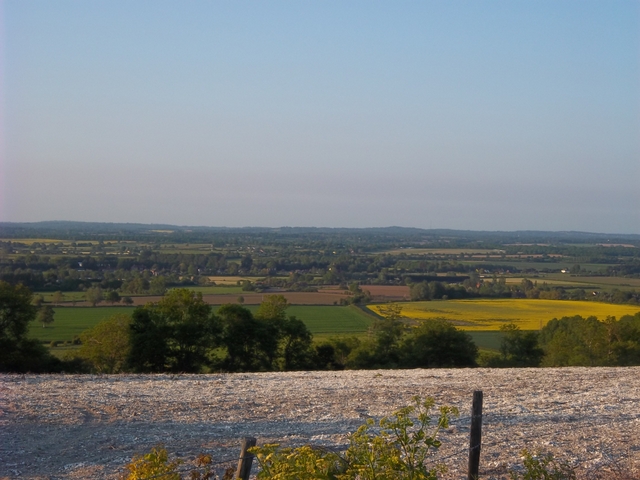
The piece I have written for the Weald - The Weald World
- is rather dark in character, reflecting the past rather than the present. To get a bleak picture, I have used mainly triads in their second inversions, rather than any jazzier chords. The first part of the tune (9 bars) is played by a trombone with plunger in unison with the tenors against harmony by the rest of the trombone section. (The use of the plunger is to create a hybrid sound to distinguish it from the other trombones. I'm not after a wow-wow effect here. The plunger is also useful because the transition to open horn is immediate.) In the second 9 bars, two of the trumpets, also in plungers, are added to the tune and the rest of the saxes double up the triad harmony and octave higher. For a brief respite the saxes play a short bridge before the tune ends with the previous set-up. The second alto player (who lives in the Weald) takes the first solo. Following that, it goes into double tempo with an ensemble passage using a lot bigger, more intense chords. The third trombonist (who lives on the other side of the Weald) then takes a solo. The tune reverts to the slow tempo and finishes with a bit of a drum flourish (the drummer also lives in the Weald). Hmm, I might be setting a new trend, using only soloists who live in the title's location. Might catch on for tunes like Moonlight in Vermont, Chatanooga Choo Choo, St Louis Blues, etc. A soundbite will be added when available..
Knowing how affectionately people feel about where they live I have written a tune which hopefully they will like even if they hate everything else. It's called My Sussex Home and is a ballad which is a tenor feature.
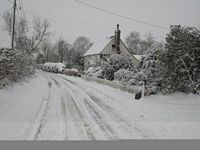
Here is a lovely Sussex cottage in the snow.
The town of Heathfield lies on the junction of the North-South Tunbridge Wells to Eastbourne road (the A267) and the East-West Hawkhurst-Lewes road (the A265). It is located almost in the centre of the county. At one time there was a rail connection to the South Coast but in 1968 it closed and the route is now a tree-lined path for walkers, horse-riders and cyclists, known as the Cuckoo Trail - a lovely quiet place for a stroll and a picnic. I've walked there many times and recommend it to anyone.
Cuckoos have a long association with Heathfield. Each Spring, traditionally on April 14th from 1315 to 1914 and now once again, Heffle Cuckoo Fair takes place. (Heffle is a former name for Heathfield.) Legend has it that the fair had to be opened by Dame Heffle who released a cuckoo from a basket. Dame Heffle was played by a gypsy. How she caught a cuckoo and stuffed it into a basket is another story.
The piece I have written to commemorate this (Dame Heffle's Cuckoo) starts with an awful lot of cuckooing in the band. A rim shot, sounding like a gun-shot, silences them leaving behind just the lead alto to play it with the saxes. The bass guitar and synth play the tune while the bass trombone plays a simple bass line. The flute then solos, followed by the 1st trombone (a rather big cuckoo, but still). There is then an ensemble passage and after that everyone gets to play 2 bars solo in succession. The tune is played again, this time by the saxes with the brass doing the cuckoo riff. No cuckoos were hurt in writing this tune, but I can't guarantee that there might be some feathers ruffled in a live performance. Here is part of the tune, preceded by...well, you can guess!
Hastings on the eastern end of the coastline dates back to pre-historic times and may have already been a port when the Romans came (55AD). From the Fifth century to 771AD it was an independent kingdom from Sussex and Kent and it attempted to retain its separate identity until the eleventh century. But following the Norman invasion in 1066 it was incorporated into Sussex and the Hastings Rape became one of the six administrative areas of Sussex. Even today, Hastings people are very different from people in Bexhill, Eastbourne and Brighton.
Fishing has always been important to Hastings and the town still has the largest beach-based fishing fleet in England. Just below the old town there are some tall black wooden buildings used to dry fishing nets. There are two members of my band who are from Hastings, so my piece is called Fisher Folk and here it is:
Here the whole piece on youtube here
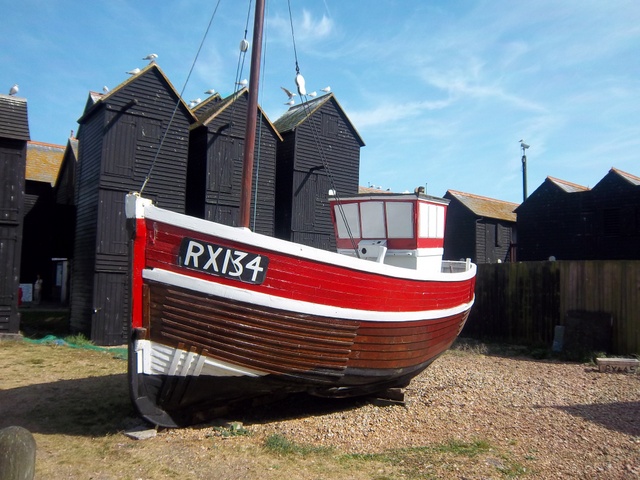
The arrangement starts with just the soprano and bass player playing the tune very slowly. There is a bit of a sea shanty feeling about the tune where the last few notes of a phrase are repeated by the other saxes. The tune is repeated, but now in quirky ensemble chords. The bass then kicks off a medium shuffle rhythm and the Hastings trumpet player takes a solo. In the second chorus the saxes are added and in the third chorus the brass come in. The Hastings soprano player then has a solo, first time with just bass, then with trombone backing joined half-way through by trumpets, and then the other saxes pitch in. Gradually the rest of the horns and piano depart leaving just soprano, bass and drums who continue at the same tempo and eventually fading away. While they are playing with themselves, the rest of the band play the tune again in unison at a much slower tempo against them. In the middle part of the tune, the horns go into harmony and then for the last few bars the soprano once again takes over until the end. You can hear the tune when we played it for the first time at rehearsal here.
Archibald Belany (1888-1938) fooled everyone for a long while. He was born near Hastings and attended the Grammar School there and spent a lot of his free time in exploring one of the local woods. He also loved playing pranks and once lowered fireworks down the chimney of the timber works beside the wood where he found work. The ensuing explosion nearly destroyed the timber works and he was fired.
He then went to Canada where he became a fur trapper and forest ranger and adopted the name Grey Owl (Wa-sha-quon-asin). He became fascinated by the Ojibwe Indians and was treated as one of them. He also became very interested in beavers...and women. From being a hunter of beavers, he changed to being a protector of them and became a conservationist.
During his time in Canada, he kept up the pretence of being half-Indian - he claimed that his father was Scottish and his mother an Apache Indian, which was not true. It wasn't until some time after his death that his real identity became known.
Having worked a lot in Hastings, none of this surprises me. There's something about the air or the fish which brings out the quirkyness of Hastings people. So if you ever visit the town, you don't know who you might bump into. Grey Owl made a big impression on others and various books and films have been written about him. Even today his influence remains strong as Hastings men are still all obsessed with beavers!
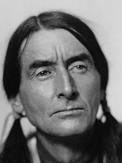
Here is the tune of Grey Owl.
Writing a piece about Grey Owl has meant using some cliched ideas about Native Indian music. So I have given the drummer free reign to play tomtom rhythms and given the flute player some pentatonic scales to play over. The tune is voiced in open fifths (trumpets and trombones) with the saxes in fourths slurring about in subtones. The second alto then gets to play an extended solo with the rhythm section and then with backing voiced in fourths. There is then a spot for two trumpet soloists (not together) before the tune comes again with a coda reverting to flute pentatonics. I thought about buying a native American flute to get a more authentic sound, but that's a bit impractical as I probably can't get one here, it might be too expensive and it may not be in tune with the rest of the band I'll have to make do with the instruction "quasi Native Indian flute" and leave it up to Anna to do her best.
I love eccentrics - they always provide lots of ideas for portraying them in music. One such eccentric was Mad Jack Fuller, who was born in 1757 in the village of Waldron near Heathfield. He went to Eton public school and when he was 20 his uncle, Rose, died leaving him some plantations in Jamaica and his Sussex estates, including that at Rose Hill near Brightling. A few years later he became MP for Southampton, which was followed by his becoming an MP for Sussex from 1801-1812. In 1796 he was appointed High Sheriff of Sussex as well as being the Squire of Brightling.
His parliamentary career was eventful in that his drunken behaviour got him into trouble and on one occasion he was ejected from the House of Commons. At another time during a boring debate he leapt to his feet and extolled the virtues of living in Sussex and left the House. He once called the Speaker "that insignificant little fellow in a wig". Admittedly He was a staunch supporter of slavery, but at those times many English people were and the wealth of the country was to a large extent based on the revenue derived from slavery. His support of slavery owes much to the fact that he inherited slave plantations in Jamaica. He derived much of his income from this source.
In his favour, he was a philanthropist and supporter of the arts. He was a mentor to Michael Farraday and loaned the Royal Institute £1000 which he later wrote of. He bought Bodiam Castle to save if from being destroyed - the castle is now one of the main tourist attractions in East Sussex.
Put mouse-over to enlarge.
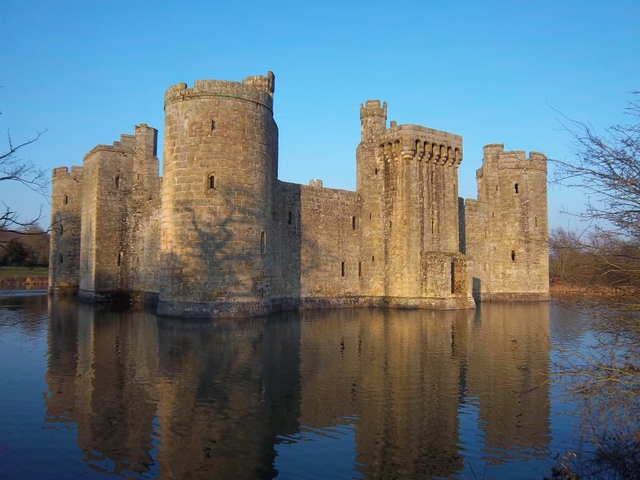
He gave Eastbourne its first lifeboat and financed the building of the Belle Tout lighthouse at Beachy Head. He built the observatory at Brightling which was designed by Robert Smirke, an architect who helped design the British Museum, Somerset House, The Royal Mint and a host of other famous London landmarks. The arist, Turner, was a frequent visitor to Fuller's house and many of his paintings were bought by him. He also presented a new organ to the church and new robes to the choir. When the vicar complained about the presence of a pub, the Green Man, opposite the church stating that it would lead to the congregation being tempted, a new pub was built half a mile away in a converted barn owned by Jack Fuller.
He was given the title mad because of the follies (meaning buildings of no practical use) which he had constructed near his home. The Temple, designed by Robert Smirke, is a Greek edifice situated in Brightling Park, which it was said was used for gambling or for entertaining ladies of the night. The Tower, measuring 35 feet in height and 12 feet in diamenter is said to have been where he surveyed the repair work being done to Bodiam Castle. Then there was the Sugarloaf, erected in one night, and the Brightling Needle or Obelisk, perhaps built to honour Wellington's victory at Waterloo.
The oddest folly was the Pyramid built in a corner of Brightling churchyard to serve as his mausoleum, although it was built 24 years before his death. Rumour had it that after he died, he was laid sitting in a chair in full evening dress and top hat with a meal and a bottle of wine before him. And on the floor were shards of glass to keep the devil away. However when the building was being repaired it was found that he was in fact buried under the ground in the normal way.
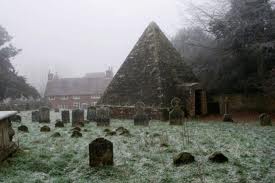
To see more of the follies, click here.
To put this character into music, I choose a 5/4 time signature with a repetitive but quirky tune. The bridge is rather atonal with a descending chromatic bass line. The last bit of the tune has a 2-beat pattern against the 5/4. The second trumpet, featuring a new player to the band, Paul Jordanous, takes the first solo. Then the key changes and it goes into a double tempo swing for a soprano solo for Simon D'Souza. They swap phrases, play together and then it's back to the written bridge and out. I have introducted a few eccentricities to go with it. In the intro and the ending, the band get to snap their fingers or clap hands - not easy in 5/4. For the background to the solos, I have written out a Dorian scale for each horn player. The task of directing ad-lib chords with each player choosing which note to play I have assigned to the 3rd trombonist (for the trumpet solo) and 4th trumpet-player for the soprano solo. The chords can be sharp, or sustained and the choice of when to play them, I've left entirely up to them. Should be fun. Mad Jack would have liked it, I'm sure. To hear the solo section of the tune, click here.Here is part of the tune - it needed a lot more rehearsal time than was available for us
If you drive some eight miles north east of Lewes, you pass Little Horsted which is now a hotel but used to be a house owned by a cousin of the Queen whom she visited occasionally when en route to the opera house, Glyndebourne, a few miles away from Ringmer. She used to worship in the little church over the road from Little Horsted Place.
Carry on and you will come to the town of Uckfield. It is possible that the town name is derived from the Celtic word uchafedd which means high. You can understand why it was given this name when you reach the town whose high street is built on a steep hill. At its lowest point there have been frequent floods, particularly in 2000 when the river Uck overflowed its banks. The signs drawing attention to this river are purposely very narrow to avoid being vandalised by anyone adding an additional letter to the word.
The ancient inhabitants of the town knew a thing or two about the danger of flooding and built the original settlement near the top of the hill on what is now Church Street.
Uckfield, which lay on the pilgrim route between Canterbury and Lewes and Chichester. does not look that old - the shops and building lining the main street date back to the early 20th century, but there are some older buildings in the town too, several of which are near the church. It dates back to the thirteenth century or earlier - much earlier if the Celtic derivation of the town name is true.
There are only two notable people (with the exception of the alto player in my band) who are associated with Uckfield. Lady Lucan (Veronica May Duncan), the wife of Lord Lucan was born in the town. He murdered his children's nanny (not in Uckfield I hasten to say) and escaped overseas, never to be seen again.
The other person who came from the town was Emma Lee French who was born here in 1836. She became a Mormon and emigrated to the USA, arriving in Chicago from where she pushed a cart full of goods donated by her church a distance of 1,400 miles to Salt Lake City, Utah. It was a hazardous trip and 150 other people in the party died on the way, Emma looked after the sick and acted as a midwife to one woman. She then married John Doyle Lee, who was said to have taken part in a massacre of Californian immigrants and the couple were kept under surveillance by the federal authorities for twenty years. I could mention other things that happened to her, but hold on, this is about East Suusex, so I will leave it to you to look her up on Wikipedia or elsewhere. My point is to show that growing up in Uckfield, particularly having to climb up and down the hill every day must have given her enormous strength and stamina. No doubt all the residents of Uckfield are similarly endowed with powerful muscles. Take care not to fall out with anyone in the town!
The tune I wrote for her is called The Life of Emma Lee.
It is a feature for alto sax, naturally, and is a 3/4 ballad which later on goes into a faster swing tempo before slowing down for the final little flourish. It gets tiring climbing that hill.
Grey Owl and Emma Lee French are not the only links that East Sussex has had with the USA. William Penn who founded Pennsylvania married Guilelma Springett, daughter of Sir William Springett of Broyle Place near Ringmer. John Harvard, founder of Havard University married Ann Sadler, daughter of the Rev. John Sadler, vicar of Ringmer Church (St Marys) from 1620 to 1640. Thomas Paine, originally from Thetford, Norfolk. came to live in Lewes in 1768 in Bull House on Lewes High Street and the house is still standing. Here he worked as an excise officer and as a tobacconist. In the White Hart Hotel opposite the Law Courts he took part in a debating society called the Headstrong Club. He later emigrated to America and helped write the Constitution. Not content with just one, he later helped to write the French Constitution. Not bad for a failed tobacconist. One wonders what might have happened if instead he had made a success of that line of business. In all, he led an adventurous life, well worth investigating if you are a fan of people who write constitutions.
The quintessential image of an English village is that of a cricket match on the village green. There have been many connections between cricket and Sussex (West and East) which is the oldest of the 18 major county clubs in England and Wales. The first mention of anyone playing cricket dates back to 1611, and later in that century cricket matches were played between villages. This is before the Civil War. Ths opposing teams in a cricket match may well have been the cause of that war!
Well-known players who have played for Sussex include Ted Dexter, Tony Grieg, David Sheppard, and the two Langridge brothers, James and John. The brothers grew up in Newick, a few miles north of Lewes and played for their local team before joining the county team and then, in the case of James, playing for England. In cricket parlance, you are given a cap to play for the country. (You may also be given a pair of trousers to play for your local team. While a lot is written about uncapped players, nothing is said about un-trousered local players - one of cricket's dark secrets.)
The Langridge brothers were given encouragement by Thomas Baden-Powell, a cricket-fanatic and cousin of Robert Baden-Powell who founded the Boy Scouts. In his elderly years, Thomas, who suffered from a physical disability, was pushed around the village of Newick in a wheelbarrow covered in red velvet (he found a bathchair too uncomfortable.)
Robertsbridge in the east of the county is famous for the willow trees which grow locally, from which cricket bats have been manufactured by the Gray-Nicolls company. Many celebrated players including Alastair Cook and Andrew Strauss have used their bats or other accessories used in the game.
For the uninitiated, the game of cricket is summarised thus:
You have two sides, one out in the field and one in. Each man that's in goes out and when he's out, he comes in and the next man goes in until he's out. When they are all out, the side that's out comes in and the side that'd been in goes out and tries to get those coming in out. When both sides have been in and out, including the not outs - that's the end of the game.
Nothing looks more peaceful and relaxing than to lounge on a deck-chair watching a game of cricket with the team dressed up in white trousers, shirts and sweaters, the majority of the players hardly seeming to move, all set on a village green, surrounded by oldy-worldy houses and a pub on a lovely summer's day. Put mouse over to enlarge.
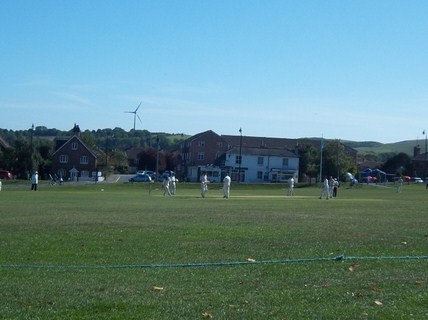
But things are not as they seem. For a start, the bowler bowls a hard leather ball, sometimes at speeds of in excess of 100 miles an hour; the batsman can hit the fast-moving ball in any direction so that the fielders must remain vigilant at all times in case they have to chase after the ball or catch it. And like every other sport, it is full of nervous tension and keen rivalries. The title of this piece is Bat'n'ball.
The opening part of the music tries to portray the idyllic rural setting. After the tune, voiced in just 2-parts, the piano plays a rubato solo before doubling the tempo. The two batsmen then come on in the form of a flute solo, and at the end of the over, a soprano solo, surrounded by members of the opposing team playing brass figures. After the saxes' innings, it is the turn of a trumpet and a trombone player to face the bowling and fielding of the saxes' side. At the end of their innings, there is a dissolve and the music returns to the original peaceful setting just in time for a tea interval. Footnote - I decided to scrap this piece as it didn't work.
I should have mentioned before the game of Stoolball, which is a traditional Sussex game first played 500 years ago. It is called the forerunner of cricket and baseball. It is played by ladies or mixed teams with 11 players in each. It is very similar to cricket but bowling is underarm, the bat is the size of a table-tennis bat with a long handle. Read more about it here. Take a look at this silent film from 1925 of people playing stoolball. And here is a 1940 film clip with commentary.
The Black Death devastated Sussex. As much as a third of the population died in the outbreak of the plague which entered the county through the ports of Rye and Winchelsea in 1348 and lasted for two years. In the country as a whole it is estimated that 20 percent of the population died. It was even worse in some other countries. In Egypt 40 percent of the population died and half of the Parisian residents out of a total of 100,000 died.
In East Sussex, several villages were abondoned altogether, others were heavily depopulated, such as Alciston, Barcombe and Winchelsea. In the village of Peasmarch, the whole village was relocated a mile away from the church which was the centre of the plague in this area and people were forced to burn their old wooden homes. In the church, the rector had three animals carved onto the stone walls - a stag below ground level in the drains to keep the rats away, a unicorn to ward off the plague from entering the doors of the church, and a mystical bird to keep the plague from coming in from the roof. Two leopards were also carved in the sides of the arch leading to the altar to prevent leprosy from entering.
In the country as a whole, there was a hunt for scapegoats to blame for the plague and people such as lepers, gypsies, friars, Jews, beggars, pilgrims, foreigners and people with skin diseases were herded together and burnt alive. This was a very superstitious period and the churches preached that the outbreak was a result of man's sin which had caused it, no doubt quoting from the Book of Revelation in the Bible.
My tune on this topic is called Revelations - a tune which I had written some time ago but it seemed relevant to include it here. Here is the tune.
The tune starts off with just 2 trumpets and 2 saxes in unison before other instruments are "infected" until the whole band is playing. There is then solo shared by 2 tenor players before a tricky ensemble passage with phrases split between the different sections and building to a climax.
There was a bit of a to-do when Glyndebourne opera house decided to erect a single wind turbine on the downs above Ringmer. The objection to it was that it would be too noisy. Being a musician I am very conscious of sounds and I have to say that I have walked all around the village and not heard it until I was very close to it. The sounds I have heard are car motors, children yelling, lawn mowers, dogs barking and aircraft passing overhead, all of which are very obtrusive. The alternative could be a coal, oil or nuclear power station with lorries delivering fuel and cars taking people to work there and back. Personally I like to see it, and you can see it from all over the village. It is nice to think that opera singers need a bit of extra wind-power - some additional fresh air for the arias, perhaps.
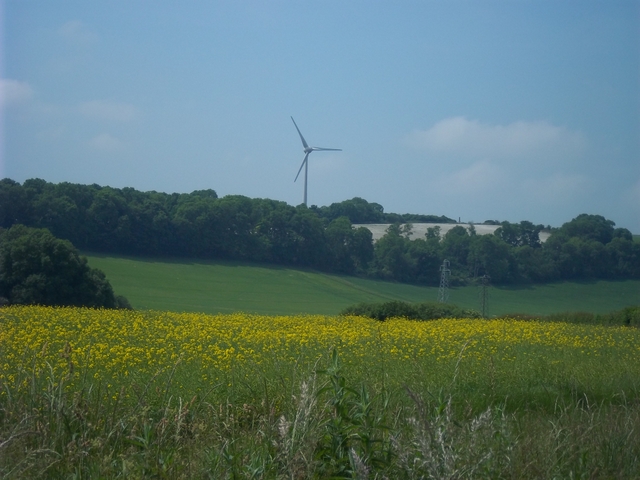
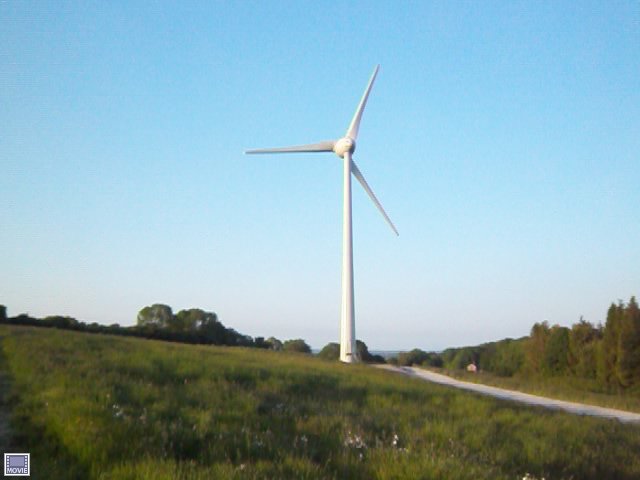
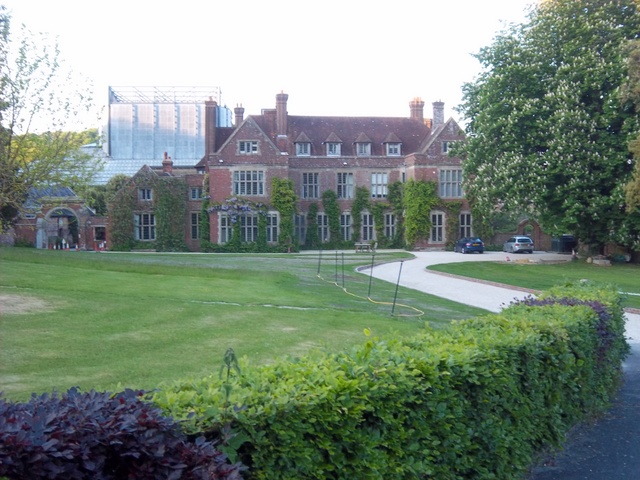
The piece is entitled "Tilting at Turbines" (with a nod in the direction of Don Quiote)). It starts off in fast 3/4 (to match the 3 blades on the turbine) with altos and trumpets playing the tune in whole notes (crotchets) and then it is played in mainly dotted whole notes using 2 flutes, soprano, 2 altos playing an octave above cup-muted trumpets with trombones lower down - a big spread. There is then an open drum solo before the tune is restated. There are the first few bars:
For anyone who might be confused about the difference between opera and jazz, this should explain everything:
In 1155 a Royal Charter established the Cinq Ports (5 ports) to supply the country with ships in times of need, in other words, for defence reasons. The original five were: Hastings, New Romney, Hythe, Dover and Sandwich. All but the first are in Kent and only Hastings is in Sussex. They were supported by the old towns of Rye and Winchelsea. There were also 8 other towns which were called limbs, all of them in Kent. A further 23 towns and villages - later amounting to 42 by medieval times - joined the confederation, including the Sussex settlements of Bexhill-on-Sea, Pevensey, Eastbourne, Northeye (which was located 3 miles west of Bexhill but now no longer exists), Hydney, now known as Hampton Park - part of Eastbourne, and Seaford (all places along the Sussex coast.) In return for supplying ships, the towns and villages were given certain tax exemptions.
Many of the places mentioned were set fire to by the French and several of them are no longer on the coast. Take Winchelsea, for instance. Old Winchelsea, possibly situated near Rye, was settled in Saxon times and after the Norman invasion, it was imnportant as a naval base for trade with the continent. In the 1260s, it possessed over 700 houses, 2 churches and 50 inns with a population of thousands. Incursions of the sea occured in the thirteenth century and a devastating flood destroyed the whole town in 1287.
In 1281 Edward I ordered Winchelsea to be rebuilt in the shape of a grid at its present location (between Hastings and Rye) and it flourished until the mid-14th century when it was attacked by French and Spanish forces and was later affected by the Black Death. The final blow was the silting-up of the harbour - it is now a mile from the sea. A town, actually a village now, whose fortunes have declined over the years. Yet even as late as 1832 it was represented in parliament by 2 MPs, until they themselves voted to abolish their seats.
Today it is a charming village which is bypassed by the main road to Rye. One of its claims to fame is that the actors Henry Irving and Ellen Terry lived here, as did the comedian and author (and jazz lover) Spike Milligan, who is buried in the churchyard. The epitach on the headstone of his grave reads, "I told you I was ill".
I've made use of an old tune of mine to illustrate the fate of places like Winchelsea. It's called "One plus one" or in full "one plus one is one" because the towns' destiny seems to be one step forward, one step back. In the case of Winchelsea it is more like one step forward and half a dozen back. It is in 7/4 (no significance in that)and features a trumpet and trombone solo. It's a long tune, so there's not much you can do with it except the tune and a few solos. An ensemble chorus would have dragged it out too long. Listen to the whole piece, featuring Paul Jordanous, Mark Bassey and Jerry Dearden here.
This is the end of this suite. I hope you have enjoyed reading about it and hearing some of the music. To finish off with, here is a short piece I entitled Yes? to see if it would work. I broke several "rules" of harmony - using the third and fourth in a major chord and a dominant seventh, using altered and natural fifths in a chord, using the minor and major third in a major seventh chord and voicing chords with a semitone between the top two notes. Here is the result:
I think it is worth using it on the gig. I shall retitle it so that I can announce that "This is Your East Sussex".
go to the Watermill Jazz Suite
go to the One World Jazz Suite
go to the 2nd part of the One World Jazz Suite